

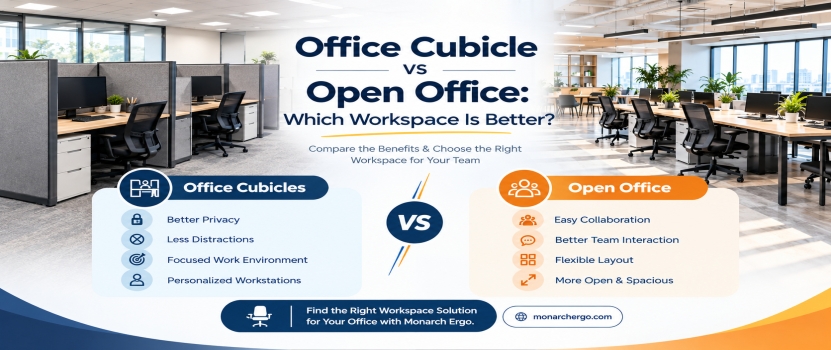
office cubicle vs open office which workspace is better
Office Cubicle vs Open Office: Which Workspace Is Better?
The layout of the office can impact the way employees operate and how they communicate with each other during the day. Some employees prefer a secluded area where they can work undisturbed while others thrive in a vibrant setting with plenty of interactions. This shows that the selection of one layout instead of the other goes beyond simply choosing a beautiful setting. It involves factors like the nature of work, the composition of the team, the space available, and the needs of the employees.
Nevertheless, each of the designs has its own perks. Knowing the main differences between the styles will help firms create office space where comfort is not compromised at the expense of efficiency.
What Makes Office Cubicles a Practical Choice?
Cubicles ensure that staff have proper desks and cubicles while not completely isolating them from the rest of the company. Unlike standard closed offices or cabins, cubicles provide a good compromise between space for privacy and at the same time accessibility.
For instance, a professional may be involved in report write ups, coding, accounting, or client documentation and may need a minimum number of distractions throughout the work day. The designated workplace can provide that sense of ownership of one’s space needed to minimize unwanted interruptions.
Cubicles also have the advantage of being organized. A well-designed cubicle can accommodate a working desk, PC, essential documents, and office items without creating a feeling of clutter.
Nonetheless, cubicles are not always the best solution for everyone. Should teams require continuous and complex face-to-face communication, the isolation created by the use of cubicles may lead to communication challenges.
Why Do Businesses Choose Open Offices?
Open offices are designed in such a way that shared spaces are employed instead of fixed workstations with partitions. This office design is preferred in industries where constant communication and teamwork is necessary.
Let’s take the example of an advertising agency that has received the task. For instance, a designer may need to contact a copywriter to receive the necessary comments from them. The latter, in turn, may need to consult with the manager of the advertisement. An open office design allows them to communicate with one another almost immediately without the need to move about too much.
Besides, open offices can make an office spacious. A company that is expanding may find it easier to rearrange desks in the open office design.
Yet, there is a downside: noise and distraction due to phone calls and conversations happening simultaneously. An open office may prove a challenge for workers who need longer periods to focus on a task.
Office Cubicles vs Open Office: What Should You Consider?
The choice of the optimal option is contingent on the way of office space usage by the employees.
For example, when the predominant form of work includes concentrating on individual tasks and therefore encouraging privacy, as in the case of building office cubicles. Furthermore, if a company utilizes teamwork in operation significantly, then an open office may be the more suitable choice.
Similarly, sound management should be taken into consideration. Various options can facilitate an appropriate atmosphere for an open office, such as the use of acoustic panels, careful location of desks, meeting rooms, or quiet zones. At the same time, cubicles shouldn’t be placed too closely to each other so that the employees have sufficient space.
Lastly, office size is vital. A well-organized office layout should create enough free space circulation and not just allow squeezing in the biggest number of employee desks.
Ergonomics Should Be Part of the Decision
Workspace design should not stop with choosing between a cubicle and an open layout. Employee comfort depends heavily on the furniture and workstation setup.
A desk that is too high, a monitor positioned incorrectly, or a chair without adequate support can contribute to discomfort over long working hours. This is where ergonomics becomes important.
MonarchErgo focuses on creating workplace solutions that consider how employees actually use their workstations. Whether a business chooses individual workstations or a shared office arrangement, suitable chairs, desks, monitor positioning, and workspace dimensions can make a noticeable difference to everyday comfort.
For instance, an employee who spends seven or eight hours working at a computer needs more than an attractive desk. The chair should provide proper support, the monitor should be positioned appropriately, and the workstation should allow comfortable movement.
Is a Combination of Both Layouts Better?
Many modern workplaces do not have to choose just one layout. A combination can provide flexibility for different types of work.
A company could have individual workstations for employees who need focused working time, along with open collaboration areas for discussions and brainstorming. Small meeting rooms can handle confidential conversations, while breakout spaces can give employees an alternative place to work when they need a change from their regular desk.
This approach recognizes that employees do different kinds of work throughout the day. Someone may spend the morning completing focused tasks and the afternoon participating in team discussions. A flexible workspace can support both activities.
Choosing the Right Workspace for Your Business
There is no universal answer to the question of which office layout is better. The right choice should be based on employee requirements, workflow, office size, privacy needs, and the nature of daily tasks.
Office cubicles can provide structure, personal space, and better focus, while open offices can encourage communication, flexibility, and collaboration. The key is not simply selecting one style but designing the workspace thoughtfully.
With the right furniture, layout, lighting, noise management, and ergonomic considerations, businesses can create an environment where employees can work comfortably and effectively. MonarchErgo can help businesses look beyond the basic layout and consider the complete workplace experience, from workstation planning to employee comfort.
Ultimately, a successful office is one that works for the people using it every day.
FAQs
1. Are office cubicles better than open offices?
Not always. Cubicles can support focus and privacy, while open offices are better suited to collaboration. The right choice depends on the work and employee needs.
2. Do open offices improve workplace collaboration?
They can make communication easier by allowing employees to interact quickly. However, proper noise management and designated meeting areas are important.
3. What are the main benefits of office cubicles?
They provide employees with a defined workspace, help reduce distractions, and offer a balance between personal space and team accessibility.
4. Can an office combine cubicles and an open workspace?
Yes. A combination of individual workstations, collaboration areas, meeting rooms, and quiet zones can support different working styles.
5. Why is ergonomics important in office workspace design?
Ergonomic furniture and proper workstation setup can improve comfort during long working hours and help employees maintain a healthier working posture.


